Why quick commerce is a density business: a Blinkit teardown
- Quick commerce looks like a delivery business, but it runs on density — packing enough orders into a small enough radius that fixed costs work.
- Blinkit’s proof: as it grew from 383 to 639 dark stores, order value per store per day rose from ~₹6 lakh to ~₹10 lakh. It got more efficient by getting denser.
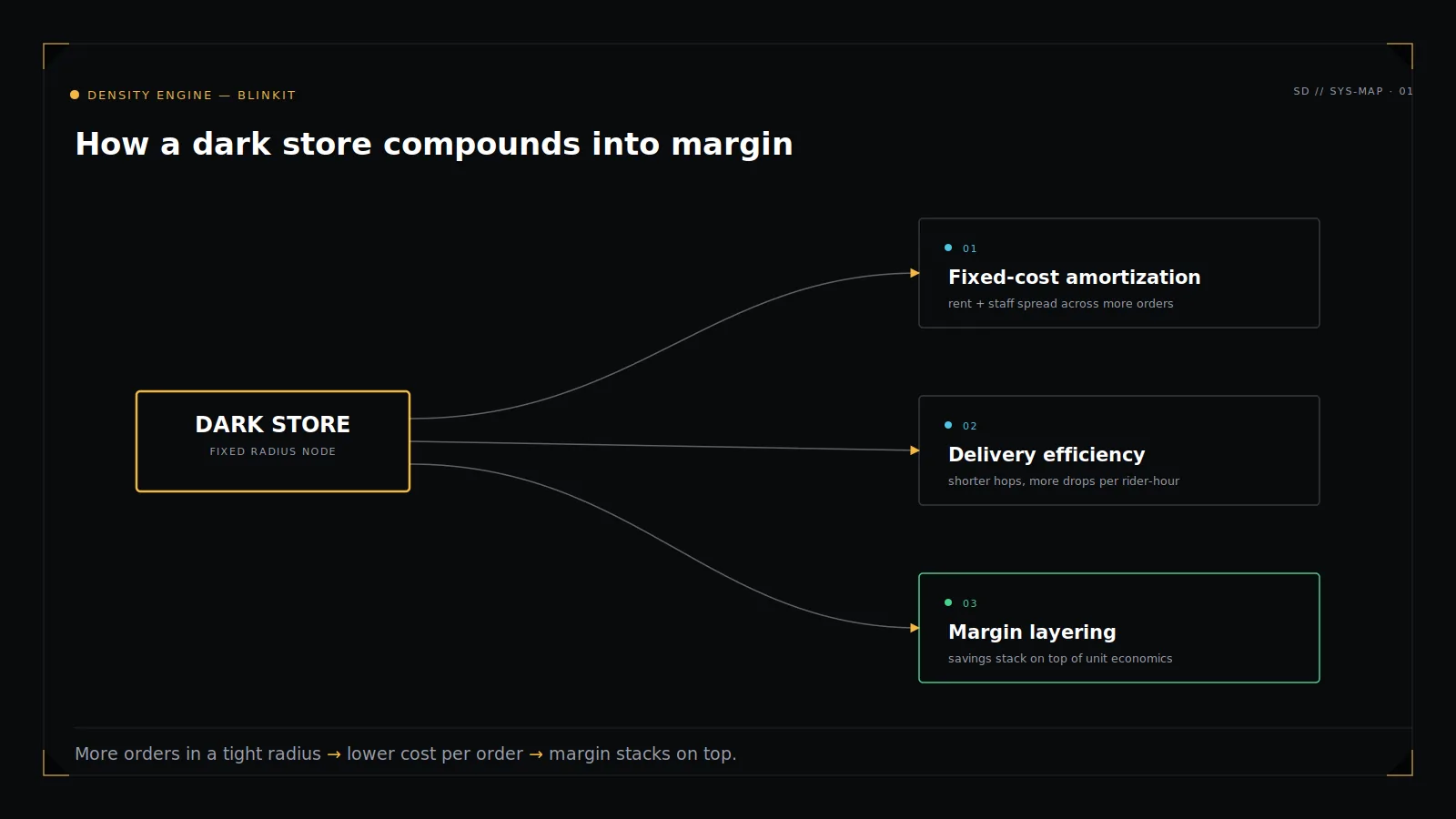
- Density pays off three ways at once: fixed-cost amortization, shorter delivery routes, and higher-margin layers (bigger baskets, retail-media ads).
- From the seller side, the same density is a tax — platforms keep 30–50% of the price, so topline growth routinely hides a negative contribution margin.
- The reusable model — the Density Threshold — applies to any business with high fixed local cost and a per-transaction variable cost.
Quick commerce is not a delivery business. It is a density business — and confusing the two is exactly why so many people misjudge whether companies like Blinkit can ever make money. The clearest proof is in Blinkit’s own numbers. As it grew from 383 dark stores to 639, its gross order value per store per day rose from roughly ₹6 lakh to roughly ₹10 lakh. It became more efficient as it got bigger — not in spite of adding stores, but because it packed more orders into the same neighbourhoods. By the quarter ending March 2026, Blinkit was operating 2,243 dark stores, processing ₹14,386 crore in net order value, and had turned EBITDA-positive. This teardown breaks down the system underneath that result.
Why does everyone ask the wrong question about Blinkit?
Most debates about quick commerce start with the wrong question: “How do you deliver groceries in ten minutes?” That part is almost trivial — a rider and a nearby warehouse solve it. The real question, the one that decides whether the business lives or dies, is: “How do you deliver in ten minutes without losing money on every order?”
The structure is unforgiving. A dark store — a small, delivery-only micro-warehouse — carries mostly fixed costs: the lease, six to eight pickers a shift, cold storage, the fit-out. Those costs don’t care whether the store fulfils 500 orders a day or 1,500. Every order then adds a variable cost, most of it the rider. And the customer expects it all in ten minutes, on an average basket of around ₹525 that might carry only ₹30–40 of contribution.
At low order volume, the fixed cost crushes the economics. The only escape is volume concentrated inside a tight radius. That is density — and everything Blinkit does is in service of crossing a density threshold per store, and refusing to operate below it.
How does density actually make quick commerce profitable?
Density pays off in three stacked ways. Together they are the engine of the model.
1. Fixed-cost amortization. The store costs the same at 500 or 1,500 orders a day. Double the orders inside the same four walls and the fixed cost per order roughly halves. This is why the metric that matters is order value per store per day — not store count, and not total GMV.
More stores, but higher order value per store — Blinkit got more efficient by getting denser. (383 → 639 figures per Eternal’s shareholder letter; 2,243 stores as of Mar 2026.)
2. The delivery radius compresses. More orders inside a 2–3 km circle means riders complete more drops per hour and travel shorter distances between them. Delivery cost per order falls as order density rises. Speed and cost stop being a tradeoff and start reinforcing each other — but only once a store crosses its density threshold.
3. Higher-margin layers on infrastructure you’ve already paid for. Once a store is dense and busy, you stack more profitable revenue on the same fulfilment base. Blinkit pushed its average basket up — from roughly ₹450 toward ₹650 — by adding electronics, beauty and other premium categories; delivering a ₹70,000 phone costs the same in logistics as ₹700 of groceries, but the margin is not remotely the same. On top of that sits retail media: advertising now makes up roughly 15% of Blinkit’s revenue, at very high margin, costing it nothing in inventory or logistics. And the shift to owning inventory directly — about 90% of orders on its own books by late FY26 — captured full retail margin and pricing control.
Stack it together — dense store, cheap fulfilment, bigger basket, ad margin on top — and a business earning ₹30–40 an order reaches structural profitability. That is how Blinkit reported positive EBITDA at ₹14,386 crore in net order value for the March 2026 quarter.
What’s the tradeoff behind staying dense and fast?
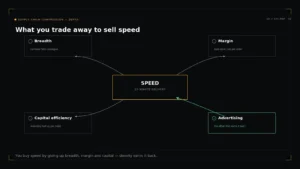
Density isn’t free. Think of speed, density, and assortment as a triangle you can’t fully maximise at once. Chase maximum speed and you scatter stores everywhere close to customers — which thins density per store and breaks the economics. Chase strong economics and you concentrate density per store — which needs real demand clustering, so you can’t enter everywhere. Try to be both dense and fast and you must keep assortment lean — only the few thousand highest-velocity products. Carry too much variety and you get dead stock, working-capital drag, and spoilage; carry too little and you get stockouts, lost orders, and density that never builds.
So the real discipline isn’t expansion — it’s restraint. Blinkit has concentrated roughly 80% of new stores in its top 8–10 cities and curated assortment to local velocity. It’s why the competitive map splits cleanly: Zepto has bought volume with discounts and free delivery, posting a large FY26 loss — volume without the density discipline — while Swiggy Instamart has shifted toward the same owned-inventory model, a quiet admission the approach is right. Blinkit’s bet is the opposite of Zepto’s: density over distance, margin from structure rather than subsidy.
What does this look like from the seller side?
Everything above is Blinkit’s view. Flip the lens to the brands selling on it, and the same density that makes the platform work is what makes it expensive to sell on — a tax the operator feels directly.
Add up commission, fulfilment, storage and warehousing, and the platform keeps roughly 30–35% of the selling price on a marketplace order. For a small D2C brand, once mandatory ad spend and write-offs are included, the full stack routinely reaches 35–50% of MRP. Blinkit’s commission alone runs a variable 2–25% by category and price band; Zepto’s sits around a blended 22–23%. And Blinkit’s ₹25,000-per-SKU-per-state listing fee is returned as ad credits — the tell that it isn’t shelf rent, it’s a media buy. These are media businesses that happen to deliver groceries: both Blinkit and Zepto crossed ₹1,000 crore in annual ad revenue by FY25.
That’s the “renting demand” tax, and it’s why, from the operating seat, the dashboard number lies. Topline growth hides inefficiency; contribution margin reveals it. Here’s an illustrative ₹800 order for a small brand advertising to stay visible:
| Line item | Per order |
|---|---|
| Selling price | ₹800 |
| Commission (18%) | −₹144 |
| Fulfilment fee | −₹50 |
| Ad allocation (₹2L/mo ÷ ~500 orders) | −₹400 |
| Net before product cost | ₹206 |
| COGS (product costs ₹300 to make) | −₹300 |
| Contribution per order | −₹94 |
Every sale makes the hole deeper. Real ROAS on quick commerce rarely clears 1.2–1.5x for small brands — you spend back nearly what you earn — and dashboards often compute it on MRP rather than the discounted price, overstating returns by 40%+. The brands that survive are the ones with 65–70%+ gross margins who rebuilt pricing and pack sizes for the channel.
The sharpest operator lesson: the same SKU is a different business on each platform. A hero SKU on Blinkit — high velocity, a favourable category commission — can be a loss-maker on Zepto, where a higher negotiated take rate and lower velocity flip contribution negative. You can’t manage quick commerce in aggregate; you build a separate P&L per SKU per platform, from settlement reports, not rate cards. Density decides which zones stock you and how fast you turn; the platform’s take rate and your ad load decide whether that velocity is worth having.
The seller-side numbers here are drawn from public data across Blinkit, Zepto and Instamart — and having run D2C growth across India’s marketplaces, I’ve lived a version of this math one channel over. The pattern holds.
The reusable model: the Density Threshold
Strip away the groceries and the model generalises. Any business with a high fixed local cost and a per-transaction variable cost is unprofitable below a density threshold and compounds above it.
Below the threshold, every location bleeds. Above it, each additional order is nearly pure contribution — and you earn the right to stack higher-margin layers on infrastructure you’ve already paid for.
This is the operating logic of ghost kitchens, gyms, retail chains, logistics hubs, EV-charging networks, even bank branches. And the operator question is always the same: what is my density threshold per location, how fast can I cross it in each new market — and do I have the discipline not to enter a market where I can’t? Most local businesses die chasing coverage. The winners chase density.
Frequently asked questions
It depends on the operator. Blinkit reported positive adjusted EBITDA in the quarter ending March 2026, on ₹14,386 crore of net order value across 2,243 dark stores — evidence the model can work at scale. Others, such as Zepto, remained heavily lossmaking in FY26, spending on discounts to buy growth. Profitability is a function of density and discipline, not of the category itself.
A dark store is a small, delivery-only micro-warehouse — typically around 1,000–2,000 sq ft — that isn’t open to the public. It stocks a curated range of high-velocity products and serves a tight 2–3 km radius, which is what makes ten-minute delivery physically possible.
Because density and speed require a lean assortment. A dark store has finite space and needs high inventory turnover, so it carries only the few thousand fastest-moving products. Too much variety creates dead stock and spoilage; too little creates stockouts. The curation is the strategy, not a limitation.
Once commission (a variable 2–25%), a ₹25,000-per-SKU-per-state listing fee, fulfilment, storage and near-mandatory advertising are combined, platforms retain roughly 30–50% of the selling price. Quick commerce works best for brands with gross margins above 65% that have reworked pricing for the channel.
Eternal Ltd (formerly Zomato) shareholder letters and Q4 FY26 results and investor communications.
Business Standard, The Economic Times and industry analyses on quick-commerce commissions, take rates and advertising revenue (2025–26).
Seller-economics analyses of selling on Blinkit, Zepto and Swiggy Instamart (2026).
// We don’t document startups. We decode them.