Zepto’s ₹5,905 crore question: what does buying speed actually cost?
- Zepto lost ₹5,905 crore in FY26 even as revenue doubled to ₹22,624 crore — but its adjusted EBITDA loss rose just 11.5%, the real sign the model is bending toward profitability.
- It still loses about ₹79 an order (₹59 in Q4) on an adjusted-EBITDA basis, while Blinkit has turned EBITDA-positive — same market, very different unit economics.
- Cost per order fell from ₹158.55 to ₹127.79 in a year as density rose — the curve works, just from a deeper hole.
- Advertising is the margin engine: ad revenue jumped 33x in two years to ₹1,636 crore, subsidising the loss-making delivery business.
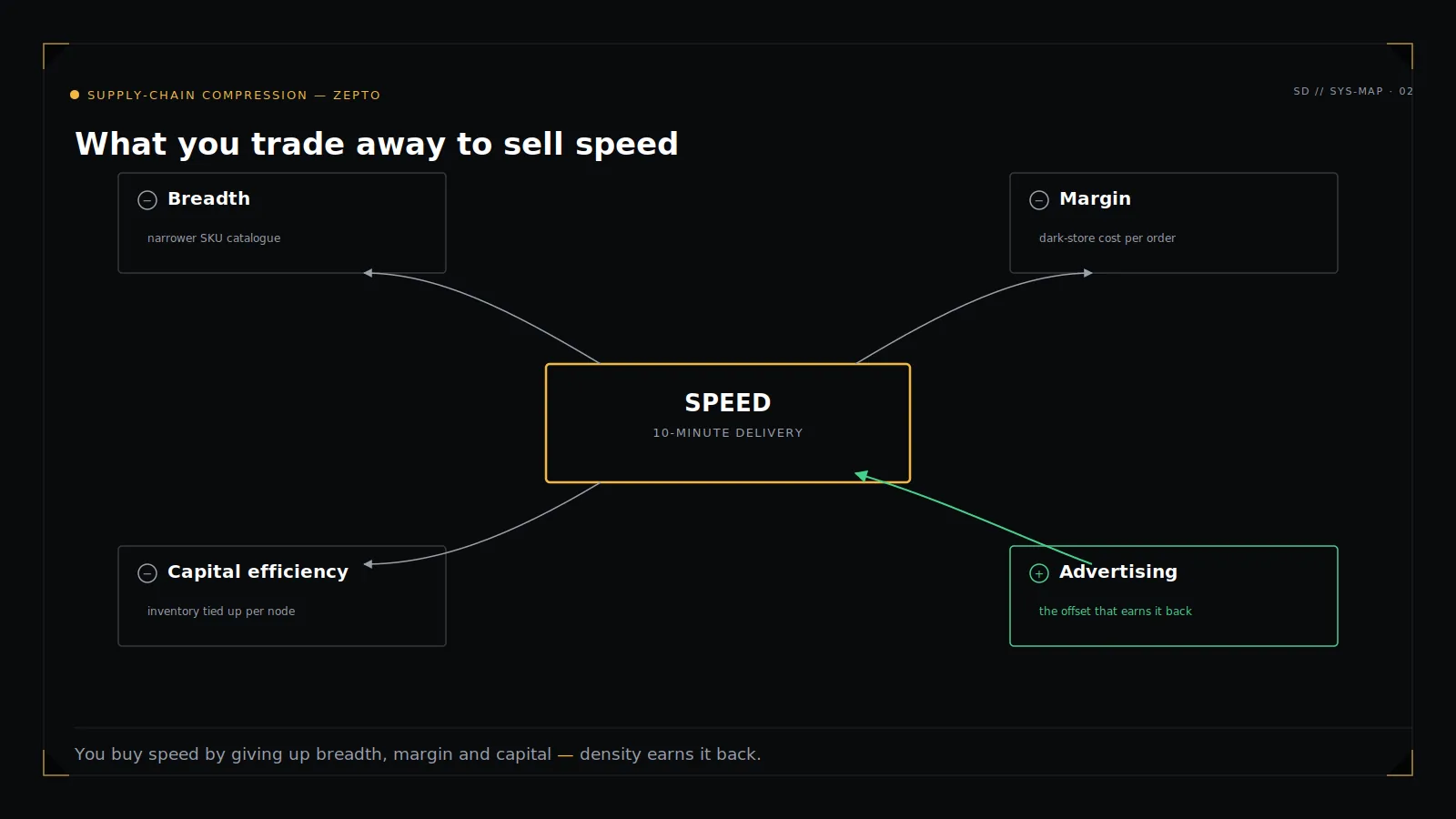
- The reusable model: Supply-Chain Compression — trading inventory breadth, margin, and capital efficiency to buy delivery speed, and the conditions under which that trade pays off.
Zepto lost ₹5,905 crore in FY26 while more than doubling revenue to ₹22,624 crore — and that gap is the entire strategy. The company spent to grow order volume roughly 93% year on year, betting that scale would pull its cost per order down the curve faster than losses could pile up. The tell that the bet might be working isn’t the headline loss — it’s that Zepto’s adjusted EBITDA loss rose only 11.5% (₹4,522 → ₹5,042 crore) while revenue doubled, and its cost per order fell from ₹158.55 to ₹127.79 in a single year. But Zepto still loses about ₹79 an order where Blinkit has turned EBITDA-positive. This teardown decodes what Zepto actually bought with all that spend, what it cost, and whether buying delivery speed can become a real business.
Companion piece: this reads best alongside the Blinkit density teardown — same market, opposite strategy. All figures below are from Zepto’s updated DRHP as reported by credible outlets in mid-2026, cited at the end.
What is Zepto actually selling — groceries, or speed?
On the surface Zepto sells groceries delivered in about ten minutes. Underneath, it sells time compression. The product isn’t the milk; it’s the removal of the trip to buy the milk. That reframing explains every downstream cost decision — because to compress delivery time, you need inventory physically close to the customer.
That means dark stores — small, hyperlocal fulfilment centres holding a curated range. By March 2026 Zepto ran 1,139 dark stores across 66 cities (up nearly 3.5x from 337 stores in 11 cities two years earlier), processed about 640 million orders in FY26 (~1.75 million a day), and served 48 million annual transacting users. Average delivery distance fell from 2.05 km to 1.83 km as it clustered stores in high-demand neighbourhoods.
The strategic tell is in the assortment. Zepto expanded from 12,312 SKUs to 49,602, pushing into beauty, electronics accessories, and home essentials — categories that carry better margins than milk and rice. Non-grocery has grown from under 5% of quick-commerce GMV in 2022 to roughly 29% in 2025. Zepto is buying speed first, then trying to sell higher-margin things through the pipe it built.
How does Zepto make money if every order loses cash?
Three revenue streams — only one of them healthy today.
The first is its take rate: the blended commission and fees it charges brands. This one is hard to pin down — reported rates vary widely by category, and Zepto doesn’t publish a single blended figure. What’s clear is that commission alone doesn’t cover the cost to pick, pack, and deliver a small basket in ten minutes.
The second is delivery and platform fees charged to customers — historically undercut by the free-delivery and discount offers used to acquire them. This is the deliberate leak: Zepto has bought volume by subsidising the customer, which is exactly why contribution stays thin even as scale grows.
The third — and the actual story — is advertising. Ad revenue exploded from ₹49 crore in FY24 to ₹651 crore in FY25 to ₹1,636 crore in FY26, a 33x jump in two years, and now makes up about 7.8% of revenue, with over 2,400 brands advertising (including brands that don’t even sell on the platform). Advertising carries almost no marginal cost — no inventory, no rider, no cold chain — so every rupee of it is dramatically more profitable than a rupee of grocery GMV. This is the flywheel Zepto is betting the company on: more users → more orders → more brand demand → more ad revenue → subsidise lower prices → more users.
Is Zepto Cafe a distraction or a margin play?
Zepto Cafe — 10-minute prepared food run out of the dark-store network — is best read as a margin-density bet. Prepared food carries far higher margins than staples and rides the same riders and real estate. When it expanded in late 2024, Zepto set a stated target of a ₹1,000 crore annualised run-rate — a target, not yet a confirmed result. The logic is sound even where the numbers are unconfirmed: use the expensive asset, the hyperlocal node, for more and more-profitable throughput. It’s the same instinct as the non-grocery SKU push.
How do Zepto’s unit economics compare with Blinkit’s?
This is the crux, and where the companion picture sharpens. Blinkit (under Eternal) won the profitability race first through density and margin discipline — building dense store networks and holding the line on discounting until contribution turned positive. The FY26 scoreboard:
| Metric · FY26 | Zepto | Blinkit |
|---|---|---|
| Orders | 640 M | 917 M |
| Share of orders* | ~33% | ~47% |
| Orders / day | 1.75 M | 2.51 M |
| Dark stores | 1,139 | 2,243 |
| Revenue | ₹22,624 cr | ₹37,779 cr |
| FY26 EBITDA | −₹5,042 cr* | +₹430 cr |
*Share of orders among scaled quick-commerce players. Zepto figure is adjusted EBITDA; Blinkit turned EBITDA-positive in FY26. Source: Zepto DRHP.
The per-order gap is starker than the totals. Zepto’s adjusted-EBITDA loss was ₹78.75 per order in FY26 (improving from ₹136.15 a year earlier, and down to ₹59.4 in Q4), while Blinkit ran essentially breakeven-to-profitable per order — it posted a small adjusted-EBITDA profit in the March quarter. Blinkit runs nearly twice the store count and pushes more volume through each, spreading fixed cost far more efficiently.
Here’s the honest nuance a SochoDigitally reader deserves: Zepto’s DRHP explicitly describes its own “densification strategy.” So this isn’t density versus no-density. It’s discipline and timing. Blinkit reached density-led profitability first while spending less aggressively per unit of growth; Zepto chose to buy volume and speed faster with heavier discounting, and is now racing down the same density curve — improving cost per order quickly, but from a much deeper hole. Zepto is the faster-growing scaled player; Blinkit is the more efficient one.
Can Zepto fund the gap long enough to win?
Only if capital stays available. Free cash flow was deeply negative at −₹4,329 crore in FY26 (an improvement from −₹5,332 crore), and the business has never had positive operating cash flow. Zepto last raised $450 million in October 2025 at roughly a $7 billion valuation, and has filed for an IPO with a ₹8,010 crore fresh issue (plus an investor-led offer for sale), reportedly targeting over ₹10,000 crore total. The founders aren’t selling any shares.
The proceeds go almost entirely toward more compression: opening more dark stores, funding lease rentals, investing in the ad-tech stack, and pushing into Tier-2 cities where rentals and competition are lower. The bet is explicit — raise public money, deepen density, ride operating leverage and high-margin advertising to profitability before the burn or the capital markets run out of patience.
One risk the headline numbers don’t show, which a full teardown has to name: the DRHP discloses that Zepto’s founders have been summoned by the Enforcement Directorate under FEMA, flagged as a risk factor with an uncertain outcome. It’s unresolved, and a sharp reader should weigh it alongside the burn. The encouraging counter-signal: the Q4 FY26 adjusted-EBITDA loss narrowed sharply even as quarterly revenue rose 75%.
Operator insight
The instructive thing about Zepto is that its losses are manufactured demand for scale, not evidence of a broken model. The unit economics improve mechanically as density rises — that part is proven. The open question is purely timing and capital: can the density curve and the ad flywheel close the per-order gap before the balance sheet forces the issue?
For an operator, the lesson is that speed is a cost you pre-pay and recover through density. You spend upfront to put inventory close to the customer, and you only get the money back if enough demand clusters around each node. Zepto’s real strategic risk isn’t the headline loss — it’s that it built network ahead of the density needed to pay for it, and is now sprinting to fill it. Blinkit did the reverse: it let density lead spend. Same destination, very different risk profile.
The reusable model: Supply-Chain Compression
Definition. Supply-Chain Compression is the deliberate shortening of the distance and time between inventory and customer by pushing stock into many small, hyperlocal nodes — paid for by sacrificing inventory breadth, gross margin, and capital efficiency.
Breadth — small nodes hold a curated range, fewer SKUs than a warehouse. Margin — small baskets, high rider cost, and discounting compress contribution. Capital efficiency — every node is fixed cost that only pays back above a density threshold of orders per node per day.
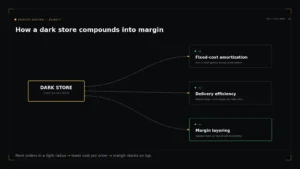
The trade pays off when three conditions hold together: demand is dense enough to keep each node busy, order frequency is high enough to amortise fixed cost, and you can layer a high-margin stream (advertising, private label, prepared food) on top of the low-margin logistics. It destroys value when nodes are built ahead of demand, discounting is structural rather than promotional, or there’s no high-margin layer to subsidise the delivery loss.
The same lens decodes q-commerce peers, 10-minute pharmacy and food, cloud kitchens, micro-fulfilment retail, even same-day parts distribution. Anywhere a business promises “faster” as the core product, ask: what breadth, margin, and capital did they give up to buy that speed — and is demand dense enough to earn it back? It’s the mirror image of the Density Threshold — density is what makes the compression pay.
Frequently asked questions
Its net loss widened about 26% to ₹5,905 crore, from ₹4,700 crore in FY25, even as revenue from operations more than doubled to ₹22,624 crore. Its adjusted EBITDA loss, a cleaner operating measure, rose only 11.5%.
Small baskets, high rider and dark-store costs to hit ~10-minute delivery, and discounting used to acquire customers keep contribution thin. Its adjusted-EBITDA loss per order was about ₹79 in FY26, improving from ₹136 a year earlier and down to ₹59 in Q4.
Its advertising business is the high-margin engine: ad revenue reached ₹1,636 crore in FY26 (up 33x in two years) at very low marginal cost, and is used to subsidise the loss-making delivery operation.
Blinkit is larger and far more efficient — EBITDA-positive in FY26 and essentially breakeven-to-profitable per order, versus Zepto’s ~₹79 per-order loss — having reached density-led profitability first with more spending discipline. Zepto is the faster-growing player, chasing the same density curve from a deeper deficit.
Zepto’s updated DRHP (UDRHP), filed with SEBI, June 2026.
Reporting on the filing by Entrackr, Inc42, Forbes India, INDmoney, Moneycontrol and Outlook Business (June–July 2026): FY26 revenue and loss, adjusted EBITDA and per-order figures, cost per order, dark stores, ad revenue, IPO structure, cash flow, and the disclosed regulatory risk factor.
Eternal Ltd results for Blinkit FY26 comparison figures.
// We don’t document startups. We decode them.